We celebrated micro:bit Live Global 2026 in Barcelona and introduced the new Diversi:Bit.
More than 500 participants from over 15 countries gathered in Barcelona for micro:bit Live Global 2026, an international event on digital education where Sistema THEAD presented Diversi:Bit, its new inclusive expansion board for micro:bit.
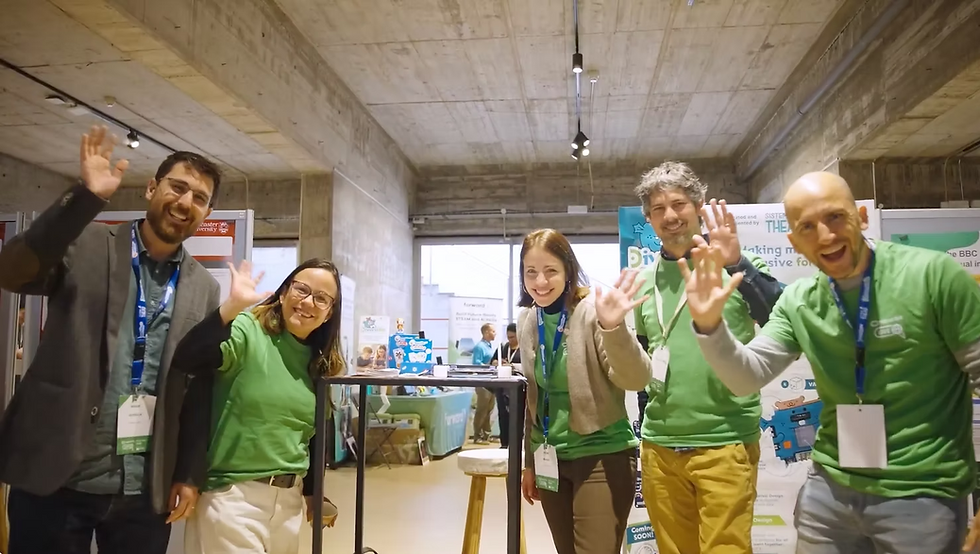
micro:bit Live Global 2026: an international gathering in Barcelona
On 27 and 28 February 2026, Universitat Pompeu Fabra – Campus de la Ciutadella hosted this free in-person event, held as part of the 10th anniversary of the Micro:bit Educational Foundation.
The event helped strengthen the international community around computing education and creativity through technology, while bringing together teachers, researchers, organisations, ecosystem partners and policymakers.
Among the attendees were also mentors from the Department of Education of the Government of Catalonia, who shared their experiences in digital mentoring and in the educational use of micro:bit in the classroom.
Throughout the event, the programme focused on:
Practical learning with micro:bit and its impact in the classroom.
Strategies for teaching computing.
Inclusion and accessibility in digital learning.
Literacy in artificial intelligence and data.
Educational research and innovation.
Relevant advances were also presented, such as the accessibility mode in MakeCode micro:bit / Blockly, with keyboard navigation and screen reader compatibility. In addition, the creation of the new MIRL – Micro:bit Innovation and Research Lab at Lancaster University was announced, with the aim of strengthening international research in computing education.
Among the featured voices at the event were:
Gareth Stockdale, CEO of the Micro:bit Educational Foundation.
Mitch Resnick, creator of Scratch and director of the Lifelong Kindergarten Group at the MIT Media Lab.
Dr. Maya Israel, expert in accessibility and inclusive learning.
Prof. Sue Sentance, an international leading voice in computing education research.
Dr. Marcelo Worsley, researcher in creative learning and emerging technologies.
Roger Olivella, co-founder of Sistema THEAD, Scratch Tactile and Diversi:Bit.

Gareth Stockdale, CEO of the Micro:bit Educational Foundation.

Mitch Resnick, creator of Scratch and director of the Lifelong Kindergarten Group at the MIT Media Lab.

Maria Teresa Corbella, CRE ONCE Barcelona
Inclusion at the heart of digital education
Roger Olivella was responsible for closing the first day. During his speech, he welcomed attendees to Barcelona and highlighted the importance of ensuring that educational technology also takes regional languages into account, as shown by the work carried out to translate micro:bit into Catalan.
He also emphasised a central idea of the event:
“Technology is not neutral: technology includes or excludes.”
Building on this idea, he argued that educational resources must be designed inclusively from the outset, so that no one is left out of learning opportunities. He also congratulated micro:bit and Blockly for their progress in accessibility and encouraged everyone to always incorporate the principles of Universal Design for Learning (UDL): offering different ways of engagement, representation and expression.
In his closing remarks, he reminded the audience that diversity is not an obstacle, but a collective strength:
“Diversity makes us better. Recognising that we are diverse is the foundation for building a more cohesive, innovative, creative, open and collaborative society.”
Highlights from micro:bit Live Global 2026
Highlights video of micro:bit Live Global 2026
Introducing Diversi:Bit, the new inclusive expansion board for micro:bit
In this international context, Sistema THEAD presented Diversi:Bit after two years of work, research and prototyping.

Roger Olivella, Co-founder of Sistema THEAD
Designed for children aged 4 and up, the board has been developed following the Universal Design for Learning (UDL) framework and has been tested with students with and without disabilities in diverse educational settings.
Diversi:Bit makes it possible to carry out activities:
without programming.
programming with icons.
programming with word blocks.
Entre els seus elements més destacats trobem: Among its most notable features are:
Multisensory interaction, with tactile, visual, auditory and vibration-based elements.
A design that encourages cooperative learning and teamwork.
The possibility of adding customisable teaching overlays, adapted to different contexts, ages or themes.
Visual and language supports, such as pictograms and short texts, to make understanding easier.
More than just a board, Diversi:Bit offers a different way of introducing electronics and programming: more open, more flexible and more inclusive from the very beginning.
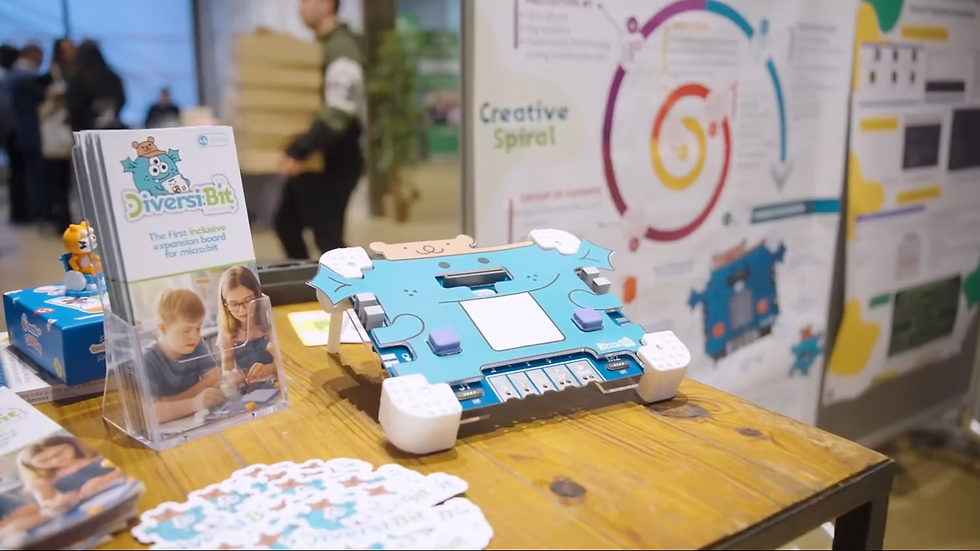
The presentation of Diversi:Bit was also an opportunity to thank the many people who have contributed to the project, especially the initial Expert Group, which helped shape the idea from its earliest stages. It was also an invitation to continue building an international community of educators committed to a shared goal: promoting a more inclusive, creative and collaborative STEAM education.
What does micro:bit Live Global 2026 leave us with?
micro:bit Live Global 2026 has created new connections, shared learning and renewed energy to continue transforming digital education.
But it also left a clear message: if we want to build a better digital future for children and young people, accessibility cannot be an add-on. It must be part of the design from the very beginning.
Would you like to learn more about Diversi:Bit?
If you are a teacher, educational centre or organisation and would like to explore new ways of teaching programming and electronics in a more inclusive way, we invite you to discover Diversi:Bit, learn more about its educational potential and follow its development closely.
More information about Diversi:Bit: